
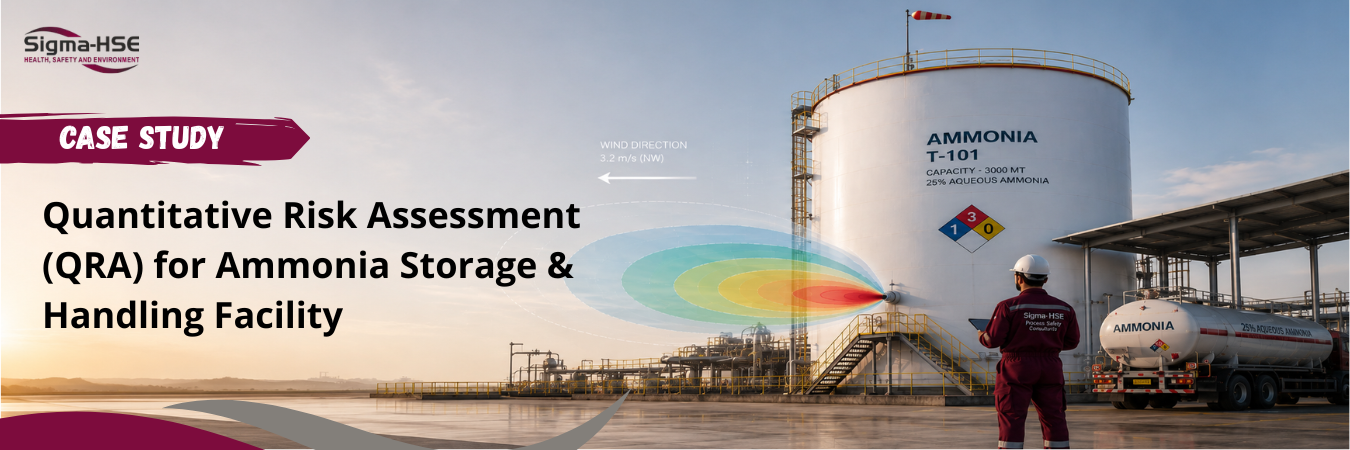
A leading specialty chemical manufacturing company engaged Sigma HSE to conduct a Quantitative Risk Assessment (QRA) for its ammonia storage and handling facility. The objective was to evaluate potential risks associated with ammonia unloading, transfer, storage, and pumping operations, and to verify that risks to personnel, assets, and the environment remained within acceptable limits.
The facility handled 25% aqueous ammonia, a hazardous chemical with toxic and corrosive properties. Potential concerns included:
Sigma HSE carried out a comprehensive QRA covering:
The study considered multiple release scenarios from:
Leak sizes ranging from small leaks to catastrophic ruptures were analyzed under various meteorological conditions.
The assessment followed internationally recognized QRA methodologies and included:
Industry-standard software (DNV PHAST & PHAST Risk) was utilized for consequence and risk calculations.
Although overall risk levels were low, Sigma HSE recommended several proactive safeguards to further strengthen safety performance:
✓ Enhanced PPE requirements for operators and emergency responders
✓ Improved spill containment systems around storage and transfer areas
✓ Protection of soil and groundwater through effective drainage management
✓ Proper venting arrangements for relief devices
✓ Continued inspection, testing, and preventive maintenance programs
✓ Periodic review of emergency response procedures
Verified that ammonia storage operations met acceptable risk levels.
Supported compliance with recognized risk assessment and process safety requirements.
Provided data-driven emergency planning and response guidance.
Identified measures to prevent accidental contamination of soil and water resources.
Enabled management to prioritize safety investments based on quantified risk results.
The QRA demonstrated that the ammonia storage and handling facility operated within acceptable risk limits. Through systematic hazard assessment, consequence modelling, and risk quantification, Sigma HSE helped the client validate the safety of its operations while identifying practical measures to further enhance personnel, environmental, and asset protection.
Sigma HSE delivers comprehensive QRA studies, Hazardous Area Classification (HAC), HAZOP, LOPA, SIL, DHA, QRA, and Process Safety Management solutions for chemical, pharmaceutical, FMCG, oil & gas, and manufacturing industries.

© 2024 Sigma-HSE (India) Pvt Ltd | Registered in India No. U93000DL2014PTC266010 | Designed By WebClixs
 India
Site
India
Site
 UK Site
 US Site